GIULI CUSTOM POOL CUES ONLINE STORE


© 2035 by The Clinic. Powered and secured by Wix
Pool Cue Styles
Pool cues come in many different varieties
What do you look for in a custom pool cue?
If your not sure hopefully this page will help you find a style to meet your needs!


Sneaky Pete Pool Cues
2 piece Cues meant to Mimic traditional bar cues
These cues can vary greatly. Traditional the cues were meant to mimic tradition 1 piece cues. A true sneaky pete joint is inconspicuous with a wood to wood joint. The purpose was for a player to have an unnoticeable better quality pool cue than what is available in the establishment where playing.
Sneaky Pete Cues are traditionally full Spliced cues with sharp points.
Modern day Sneaky Pete cues tend to stray from the original principles of the style, Most have cnc'd points, Inlays, noticeable Joint colors.
While they are still sold as Sneaky Petes they are not so sneaky
A true Hustler style cue will not have any frills about it and be hard to tell from standard 1 piece cues

Plain Jane Playing Cues
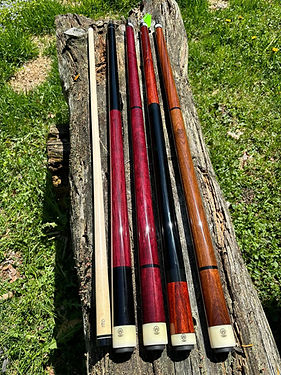
Simpe Cues- No frills: Just fine woods
These Cues are basic In design NO Inlays or Points
Some would consider this type of cue and entry level cue or beginners cue. However, as a true wood lover, I try to use highly figured and high quality woods to showcase the woods true beauty.
These cues play as well as any of my higher priced cues. The Just focs on the woods natural beauty.
These handmade cues are built with exotic hardwoods, such as: Cocobolo, Ebony, Purpleheart, Bacote, Ziricote as well as many other species and burls.
The can also be made by staining suitable species like maple to a varitey of colors

Break Cues
Break Cues are designed for Breaking the Racks
You never want to break with your shooting cue, it can cause many issues in your game. Mushroomed tips broken ferrules and shafts. Typically playing cues are built for the more precise side of the game.
Break Cues are typically designed to withstand the extreme power of break while exerting the power to the balls.
Some break cues use phenalic and other specialty materials and construction. Hard tips, stout cue construction.
There are considerable conversations about optimal weight
some people prefer light cues down to 15 oz other prefer heave upwards of 26oz.
We land in the middle and create our break advantages from the cues design techniques.
Full Coring, Hard Woods, Big pins , phenalic Joints, thick ( 13mm) rock maple shafts. hard tips & Speacialty ferrules
Giuli Break cues are called
C4 Breakers-
offering explosive Power
Merry Widow Pool Cues
Merry Widow Pool Cues are considered cue designs that have inlays and designed rears but NO POINTS or forearm work.
This style cue is often considered an intermediate cue.
They generally carry a heftier price point than a plain jane or basic cue because of the added work.
A quality merry widow style cue will have a good balance between the rears inlay work and color and figure of wood used in the forearm.
Here at Giuli Custom Pool Cues, we offer a few different merry widow variations. You get the same great performance with a little more glitter.

Wrapless Pool Cues
Wrapless Pool Cues are named that way because they do not have a wrap style or leather hand grip area.
Some wrapless pool cues usually utilize high quality hardwoods for the handle area that are visually appealing.
Some cues break up the handle area into multiple pieces with ring work or some other divider, these types of cues would be considered segmented handles.
Some cue makers finish over the linen wrap to give their cues a wrapless feel like a Meucci.
Carbon cues generally do not have wraps as well and would be considered wrapless.
Other common grip coverings
Irish linen
Leather

Pool Cues W/ Basic Points
Points on pool cues come in all different options and styles.
Each cue can vary greatly between the amount of points,
materials used, color combos, Spliced or machined, Quantity, Solid or veneered , Inlays or not.
You can generally tell a CNC or machined point by the
Rounding at the tip.
Spliced points are usually very sharp at the ends.
